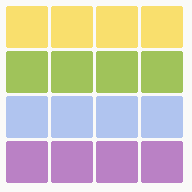
NYT Connections Hints, Answers & Clues -
NYT Connections #1041 Tip
Every word here moonlights in at least two completely different worlds.
What Makes NYT Connections #1041 Tricky?
Words like ROOT, KEY, STEM, and COMMON sit in this grid wearing their most familiar faces — musical, botanical, mathematical, political — and none of those obvious readings will get you all the way home.
The editor's trick is that almost every word has a strong pull toward a second or third category, so your first instinct about where something belongs is likely the wrong one.
This is a hard puzzle — one group may click quickly once you spot the angle, but the other three require you to hold multiple meanings in your head simultaneously and choose the least obvious one.
Connections Hints for Every Word in the April 17, 2026 Puzzle
DOMINANT
Connections hint for DOMINANT
In music, the fifth degree of a scale — but here it means prevailing or having the most influence.
KEY
Connections hint for KEY
Yes, it is a piano key and a musical key — but neither of those is what this puzzle uses it for.
ROOT
Connections hint for ROOT
The underground part of a plant that anchors it and absorbs water — the botanical reading, not the musical chord sense.
TAN
Connections hint for TAN
The back half of a well-known gin-based cocktail — not a colour or a suntan.
TONIC
Connections hint for TONIC
The back half of a classic mixer-based drink — not the musical home note or a health remedy.
STEM
Connections hint for STEM
The stalk of a plant that carries water and nutrients between root and leaf — the botanical part, not the music notation mark.
HAMMER
Connections hint for HAMMER
Inside a piano, a felt-covered hammer strikes the string to produce sound — a literal mechanical part.
GENERAL
Connections hint for GENERAL
Means widespread or applying broadly — here it signals something prevailing across a whole population, not a military rank.
BULB
Connections hint for BULB
The swollen underground storage organ of plants like onions and tulips — a distinct vegetable part.
SODA
Connections hint for SODA
The back half of a whisky-based highball drink — not a standalone fizzy drink here.
COMMON
Connections hint for COMMON
Means occurring frequently or shared widely — here it signals something prevailing, not a village green or a legal term.
STRING
Connections hint for STRING
The taut wire inside a piano that vibrates when struck by the hammer to produce a note.
STORMY
Connections hint for STORMY
The back half of a rum-and-ginger-beer cocktail — not a weather adjective.
LEAF
Connections hint for LEAF
The flat green part of a plant that carries out photosynthesis — a straightforward botanical part.
PEDAL
Connections hint for PEDAL
The foot-operated lever on a piano — the sustain pedal is the most familiar — a literal mechanical part.
POPULAR
Connections hint for POPULAR
Means widely liked or favoured by many people — here it signals something prevailing, not a musical or cultural reference.
Traps & Misdirects Hints for NYT Connections Puzzle (#1041)
ROOT is the foundation of a musical scale, KEY is what you press on a piano, and STEM is a music notation term — the music theory cluster feels airtight. That reading is a dead end. These three words belong to different categories in this puzzle, and at least one of them is doing something botanical instead.
COMMON means widespread, POPULAR means widely liked, and KEY can mean crucial or central — grouping them as words meaning important or widespread feels natural. That association does not hold here. Each of these words is being used in a different sense than the one that makes them feel like synonyms.
In music theory, TONIC is the home note of a scale, ROOT is the base note of a chord, and KEY is the tonal centre of a piece — this trio is practically a music theory textbook. None of that is what this puzzle is doing with them. At least two of these three belong to completely separate groups.
STORMY suggests weather, TAN suggests a colour or sunburn, and SODA suggests a fizzy drink on its own — they look like three unrelated words with nothing in common. That surface reading is the trap. These words are not standalone — they are the back halves of longer compound drink names.
Connections Hints for April 17, 2026
Yellow Connections Hints
Yellow Category Hint
Four distinct anatomical sections of a plant
Think: Think: what a botanist labels
Yellow Category Name
VEGETABLE PARTS
Yellow Category Words
Reveal word 1
BULBReveal word 2
LEAFReveal word 3
ROOTReveal word 4
STEMGreen Connections Hints
Green Category Hint
Words meaning widespread, ruling, or widely accepted
Think: Think: synonyms for widespread
Green Category Name
PREVAILING
Green Category Words
Reveal word 1
COMMONReveal word 2
DOMINANTReveal word 3
GENERALReveal word 4
POPULARBlue Connections Hints
Blue Category Hint
Physical components found inside or on a piano
Think: Think: what a piano technician touches
Blue Category Name
PARTS OF A PIANO
Blue Category Words
Reveal word 1
HAMMERReveal word 2
KEYReveal word 3
PEDALReveal word 4
STRINGPurple Connections Hints
Purple Category Hint
Each completes a two-word cocktail or drink name
Think: Think: what follows Dark, Gin, Harvey, Dark
Purple Category Name
SECOND HALVES OF DRINK NAMES
Purple Category Words
Reveal word 1
SODAReveal word 2
STORMYReveal word 3
TANReveal word 4
TONICNYT Connections Answers for April 17, 2026
NYT Connections Answers Explained: April 17, 2026
VEGETABLE PARTS
BULB, LEAF, ROOT, and STEM are the four main anatomical parts of a plant — each one a distinct structure with a specific biological role, and each one a word the puzzle uses in its most literal botanical sense.
- BULB
- A bulb is a swollen underground storage organ — onions, garlic, and tulips all grow from bulbs — packed with nutrients for the plant.
- LEAF
- The leaf is the flat, usually green structure where photosynthesis happens — the plant's food factory.
- ROOT
- The root grows underground, anchoring the plant and absorbing water and minerals — the puzzle uses this botanical sense, not the musical chord-root meaning.
- STEM
- The stem is the stalk that connects root to leaf, carrying water upward and nutrients downward — the puzzle uses this plant-anatomy sense, not the music notation sense.
PREVAILING
COMMON, DOMINANT, GENERAL, and POPULAR all mean prevailing — widespread, ruling, or broadly accepted — and the puzzle strips away their more colourful associations to use each one in this plain synonymous sense.
- COMMON
- Common means occurring frequently or shared across a wide population — the prevailing sense, not a village green or a legal estate.
- DOMINANT
- Dominant means having the most influence or being the ruling force — the prevailing sense, not the fifth degree of a musical scale.
- GENERAL
- General means applying broadly or across the whole — the prevailing sense, not a military rank or a proper title.
- POPULAR
- Popular means widely favoured or accepted by most people — the prevailing sense, not a reference to fame or pop culture.
PARTS OF A PIANO
HAMMER, KEY, PEDAL, and STRING are all physical components of a piano — the mechanism that turns a finger press into a musical note involves every one of them working together.
- HAMMER
- Inside a piano, a small felt-covered hammer is flung against the string when a key is pressed — it is the part that actually makes the string vibrate.
- KEY
- The key is the lever you press with your finger — the piano's most visible component, and the one most likely to mislead players toward music theory.
- PEDAL
- The pedal is the foot-operated lever at the base of the piano — the sustain pedal is the most commonly used, holding notes after the key is released.
- STRING
- The string is the taut wire that vibrates when struck by the hammer — each key has its own string or set of strings tuned to a specific pitch.
SECOND HALVES OF DRINK NAMES
SODA, STORMY, TAN, and TONIC are each the second word in a well-known two-word drink name — none of them works as a standalone drink, but each one completes a classic.
- SODA
- SODA completes Whisky Soda — a simple highball of whisky and soda water — the first half is the spirit.
- STORMY
- STORMY completes Dark and Stormy — a cocktail of dark rum and ginger beer — the first word is Dark.
- TAN
- TAN completes Gin and Tan — a drink mixing gin with tonic and a splash of bitter lemon — the first half is Gin.
- TONIC
- TONIC completes Gin and Tonic — one of the most famous two-word drinks in the world — the first half is Gin.